North Korea
A Korean man stopped me in the street the other day and asked where I was from. "Canada?" he repeated, "I hear you have good weather in Canada." An awkward (what an awkward word that is to spell) silence followed. The man was waiting for a response, and I, believing he was being sarcastic was waiting for laughter. Finally, I laughed and he repeated the question. I didn't think anyone associated Canada with good weather. Usually people get an uncomfortable look on their faces as they picture all the snow. I have to admit, however, that for the last few weeks I have been keeping an envious eye on the Canadian weather forecasts. We have had weeks and weeks of rain. I have been contemplating this abundance of rain for three days, as I watched yet another long week-end melt away with the bad weather. It's rained so much that I have come beyond the point of being depressed about it. I've decided no longer to acknowledge it. To avoid it at all cost. Or perhaps I have just had it ingrained in my head that the filth of the rain is to be avoided at all cost. A woman insisted on walking me from the subway to my destination the other day, as I turned up sans umbrella in the spitting rain. It wasn't raining hard at all, but the woman was quite upset that I was being drenched in acid rain as we spoke and ordered me to shower when I got home. I thought monsoon season sounded intriguing before I came. I have seen very few true downpours in my days, but even through all this rain I have still seen few. Slow, drizzly rain is what we've seen for weeks, maybe months on end.
 The Demilitarized Zone
With this in mind, I peeled myself from my bed Sunday afternoon, determined not to allow my entire week-end to be a waste. I cringed at the thought of finding myself at a museum in Seoul, no doubt absolutely packed with uninterested children and their parents who refuse to believe that God rested on the seventh day. Or perhaps they believe that only once their children have obtained the status of a deity are they permitted to have a day off. Difficult to say, really. I suspected that many families would be driving straight from church to the museum, and I for one am sick of being the most interesting thing on display in these museums. So I made my way to the bus station, paid fourteen hundred won (1.40$) and headed to Paju, the northern most city on the western side of South Korea (That's some complicated geography- everyone ok? There was no east involved in this trip, very important that). I took my seat on the bus, opened my book and contented to entertain myself with the changing cityscape over the next hour. It was only then that it occurred to me I had not checked to make sure I was on the right bus. I was following directions from a guide book, and more often than not the directions are not entirely accurate. I turned to the young Korean woman next to me and asked, "Odu san, odi-eyo?" (Where is Odu Mountain?). Quite satisfied that the woman had understood me, inspite of my complete bastardization of the Korean language, I sat back as she asked the bus driver the same question. I was glad it was her and not me. He launched into a long, detailed, complicated, animated explanation... little of which I understood. At the end, the woman turned back to me and in broken English replied, "Last stop." I knew there was more to it, but I was quite content to take my trip one step at a time. After all, in a small country of 50 million people you'll never be alone long. I thanked the woman and went back to my book. The woman proved to be just as attached to her cell phone as most Koreans, and spent the next twenty minutes calling one person after another. The ringing of her cell phone and her calm voice had blended in with the bus noises and I barely heard either of them. So I was surprised when she tapped my on the shoulder and passed me her cell phone. The woman on the other end instructed me to get off the bus at the last stop and take a taxi the rest of the way. I thanked both women, wondering if Canadians were ever this helpful to travellers. The bus emptied out and I was soon alone with the driver. He passed me a chocolate and again asked where I was going, directing me to the line of taxis when we arrived at the bus station. A long cab ride and a brief shuttle bus trip later, I finally arrived at my destination. The Odu Mountain Unification Observatory, formerly the site of the Gwanmi fortress. It's strategic location in the mountains, sitting where the Han river and the Imjin river meet, not to mention it's proximity to North Korea had made this spot an active part of Korean history.


Sketchy Asprin

Exert from an English text book, published 1999.
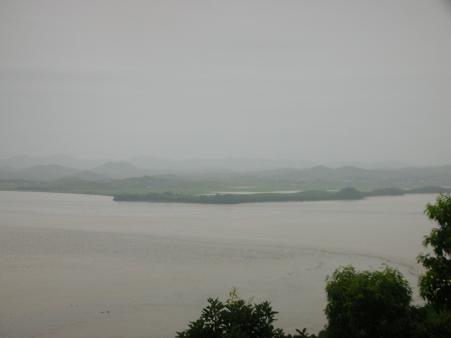
As I entered the observatory, I looked out towards North Korea- just across the river. A short three kilometers from the place where I stood was the world's most heavily guarded border. The tops of the rolling green hills poked through the clouds that appeared to be billowing like smoke as far as I could see. I wasn't sure what I had expected, but what I saw was a perfect fit for such a secretive country. It all looked so mysterious. I could see a few scattered apartment buildings, but for the most part, everything was green, as far as the eye could see. Well, that's not exactly true. There was at my feet, the Han river separating the two countries and it flowed a sickly, polluted shade of brown. I wondered how the trees could be so lush and green when I could see garbage floating in the river. Suddenly the observatory itself seemed like the most ridiculous thing I could imagine. It was like a museum, set up to watch people caged not too far away. There is little known about the endangered species that we call North Koreans, but we have set up a massive observatory to watch them through binoculars. A place where South Koreans and foreigners alike will flock, hoping to catch a rare glimpse of a North Korean. I thought about how frustrated I had been when I arrived that my every movement was watched as though I were an exotic animal. I wondered how aware the residents of the North were of the fascination with which others regarded their country.
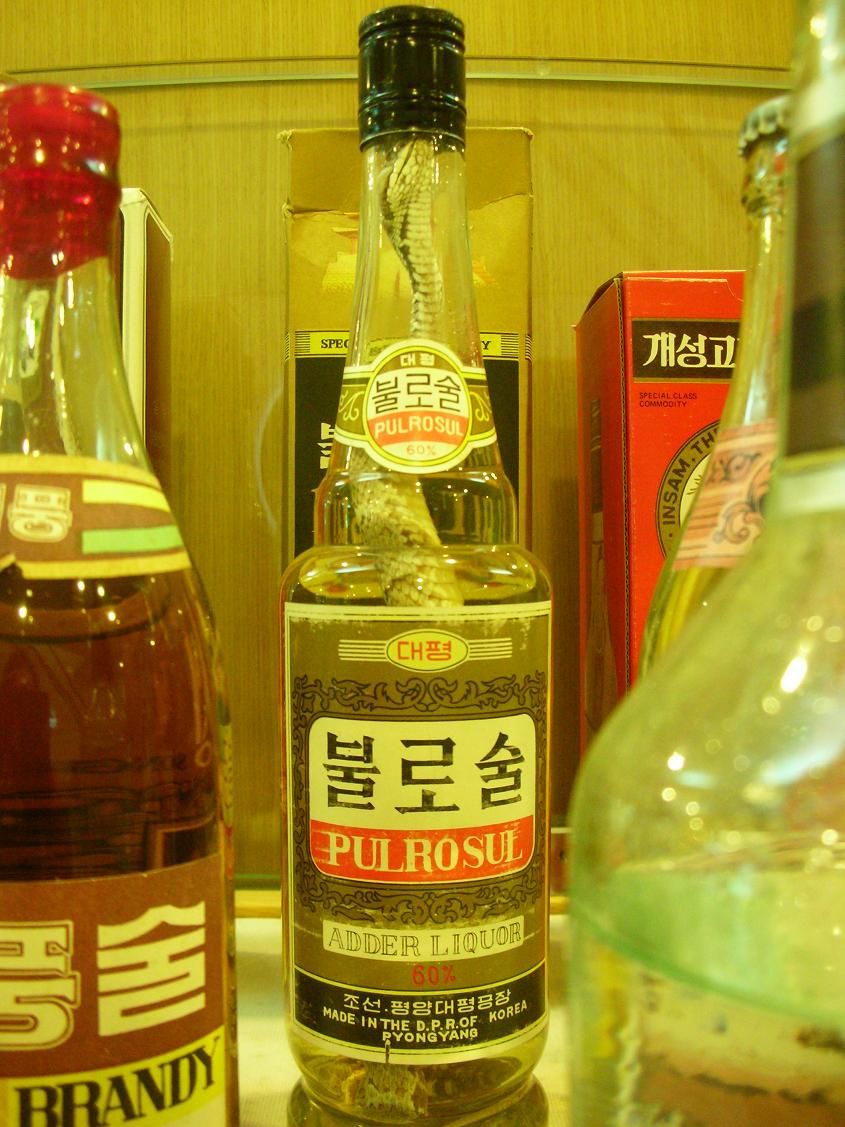
Weird alcohol complete with snake...

English textbook, published 1999.
I made my way through the observatory and came to a display room. A simulated North Korean classroom had been set up, complete with textbooks. They would have fit right in with the books that my mother still has from her Elementary school days, except that the publication date on the cover was 1999. The one English text book allowed some insight into the education of their children. Kim Jong Il was referred to as a warm and caring leader. I looked up from the book and saw his beady eyes, and those of his father Kim Il Song staring down at me. I moved along. The next room was filled with clothes, toys, books and tools that were considered to be modern in North Korea, all of them appearing to be from the 1930s. Beside these ancient tools were display cases of products produced in the north. I was well aware that there were clothing factories and that Hyundai had recently set up factories as well (not necessarily for cars, they make everything here). It was still shocking to see Samsung products alongside the old school wooden tops. The people working in the factories were evidently aware that their quality of life was quite different from the south.I couldn't say I was completely blown away by the experience. The trip had not educated me as much as I had hoped, had not put the issues directly in my face. But it did prompt a lot of thought about communism and democracy, about socialism and the market economy. There is no greater example of the extremes between the north and south of Korea. While southern Koreans strive to compete against their neighbours for the prettiest daughter, smartest son, biggest car and greatest display of brand name products, north Koreans struggle to survive. Many starve to death while my kids complain about their food being cold. As a child, I remember my parents telling me to finish my food and making me listen to stories about children starving in Africa. Having no idea where Africa was, and wondering why my parents didn't just give my Brussel sprouts to them, it had little effect on me. But I wonder what sort of awareness south Koreans have of this very issue. Their excess, while the other half of their country starves. As much as they speak of the pain of a divided nation, I can't help but wonder how much individuals actually think about how fortunate they are not to have been born forty minutes further north. The extent to which image rules the lives of the people here has shocked me since I arrived and will continue to shock me, even after I leave. I will never understand why a country with such a rich culture and history has become the world capital of plastic surgery- obsessed with bigger breasts, double eye-lids, rounder eyes, longer tongues. Why are they obsessed with being thinner, taller and covered in more European brand names than their neighbours? Are these principles anymore enriching to a person's life than those instilled by a dictator? South Koreans have chosen to allow themselves to be prisoners of materialism, while their friends and families to the north know absolutely nothing of the styles of Prada and Burberry. The two Koreas have gone such totally different directions, is unification even possible? Do they even hold anything in common anymore?

Kim Il Song and his son & successor, Kim Jong Il over the blackboard in a fake classroom.