Showing posts with label wayguk. Show all posts
Showing posts with label wayguk. Show all posts
Sunday, September 24, 2006
East/West Relations
In Korea, man is king. Korean men are raised to expect that one day their wives will be gentle, caring and attentive with them. Who would give that up for a woman who will tell you when she's going out, not ask? For a woman who might cook, but only if he does the dishes? The combination is like oil and water, they just don't mix. After all, I wouldn't take too well to a man who expected these things of me.
One of my biggest frustrations this year has been with the lack of respect shown for my culture. I recognize I'm a guest here, and I need to accept Korean culture. And I have made an effort, but I have to draw the line at some point. When I'm out and about in the streets of Seoul, I accept Korean culture. I absorb it, I enjoy it, I suppress my frustrations with it. But when I arrive at school, I quickly lose my patience. I have tried to stress to the Korean teachers and the children the importance of learning about Western culture if they want to learn the language. It is impossible to properly learn a language without a concept of how the culture works. But this has fallen on deaf ears. In my culture, it is rude to laugh at others because they are different. But try as I might to express this to my kids- and my co-workers, they simply don't understand. They not only fail to see an issue, but in fact feel that being different is an adequate reason to be laughed at. It is frustrating that because Korean society is so regimented and there are rules for who deserves the most respect, those of us who fall outside of the rules don't get respect. It is so difficult to remember that as frustrating as it is to be treated like a new and interesting play thing, it is simply because Koreans have yet to find a place for foreigners in their culture. Working out the kinks, I suppose. The line between Korean and foreigner is clear cut. After eleven months, I can't help but roll my eyes when I'm asked absolutely ridiculous things about my culture. Like if we sometimes eat dinner at restaurants. Or if we drink beer in pubs. As though all the McDonald's restaurants in Canada are only a facade because Canadians only eat in the privacy of their own igloos. Much like the old English/French divide in Montreal, the Korean/English gap is wide in Seoul. I wonder if in the years to come, Korean culture will change by leaps and bounds and find reconciliation not only with a new language, but also with a new culture. As I prepare to leave Korea, I feel a bit like I'm leaving home. I know I'll always have a soft spot for Korea and I look forward to coming back here in ten, twenty and thirty years and seeing first hand how much of an impact we made by being here. I hope to see many blue-eyed Korean children on my next visit.


Sunday, September 10, 2006
A Severe Case of Commitment Phobia
I have always suffered from a severe phobia of commitment. From the time I moved out of my parent's home at the age of eighteen to twenty-one when I moved to Montreal, I count five apartments and twelve roommates. Alex was the only one that lasted a full year. The perpetually complex state of my revolving-door relationships must have been difficult for my friends to follow. Until I met Fred, the longest of these had lasted four months. The first of these four month relationships, was of course the infamous Rob who I believe was forced out of the apartment after promising to move to Montreal with me and revealing he believed we were 'meant for each other'. Famous last words, it would seem. The second of these was the less than infamous Daniel who was kept a guarded secret (one that mysteriously leaked out anyway, Caycee) because of the questionable age difference between us. Daniel saved me the trouble of ending our relationship at the four month mark when he announced he was moving to Ireland to pursue his Master's in Acting (or some such non sense). But Daniel had not yet boarded the plane when I met Fred. I distinctly remember telling Fajer (my roommate of the moment), that Fred terrified me because I had the unsettling feeling that he might break through the four month expiry date. It seems that uneasy feeling was right- here I sit four years later wondering how it is that he snuck up on me like that. I have come to realize that this fear of commitment is not unique to roommates, apartments and boyfriends. It seeps into every aspect of my life. I hate to make plans ahead of time- commitment phobic, you see. More than anything, this commitment phobia has affected my direction with theatre. Teachers and fellow students in school told me that I was a bit of a mystery to them- I had all the pieces to be really successful, but I was choosing not to put it all together. It's true. Putting all those pieces together means making a commitment to myself, to follow through. It means no more excuses, no more bad jobs. It means making a real commitment to theatre.
I glance at my fancy Korean cell phone and realize that the countdown it began long ago to my final days here is fast approaching. As I stumbled in late last night from a day out with Song, I began to feel the first pangs of resistance. Was I ready to leave? For months I had promised Song that I would be back, but the realization has begun to hit that this may be it. Maybe I won't be. Throughout this year, Fred and I have talked many times about returning to Asia together in the future. Part of me loves to believe that it'll happen, but another part of me wonders. I have been bitten by the travel bug- it is certain that I will find myself back 'dans ce coin', but in promising Fred and Song that I'll be back, I suddenly feel as though I'm promising to put my life on hold again. Life in Canada has been on pause for nearly a year now- my career and education plans put aside for a time while I take a year to work on me. The only thing that has changed in Canada is my relationship with Fred. It's continued to grow and change as it needs to under these odd circumstances. In saying that in two years we'll be back, implies that we'll be perfectly willing to again pause our lives in Canada and return to Asia. I'm not sure that's reality. I have found a direction this year. I have come to realize that committing to theatre does not need to mean a commitment to poverty. It doesn't necessarily mean that I am deciding to pursue acting at the exclusion of other interests.
Years ago someone told me that Sesame Street was to blame for the existence of Attention Deficit Disorder in our generation- that we had become so accustomed to receiving a full story in the space of a minute or two that this later affected out ability to focus in school. Perhaps. If this is true, than it is not only my knees that bore the brunt of my active childhood. My parents encouraged and supported my involvement in ballet, gymnastics, figure skating, soccer, basketball, baseball, swimming, synchronised swimming, horseback riding... the list goes on and on. It wasn't until I reached high school that the line was drawn, as it seemed that it was suddenly impossible to participate in everything that I wanted to. My activities were grudgingly narrowed to drama, soccer and basketball. Maybe this is where the reluctance to commit stems from. There's so many choices, so many options- why commit? Why should I choose? To be honest, I've come to realize that it is just not in my nature. There is too much to life that I want to experience, and I've acquired interests and skills in too many areas to say that 'this is it'. My reluctance to commit to theatre is exactly that. I have scattered passions, and I want to pursue them all. And I've realized I can.
Months ago I began to have minor panic attacks at the thought of returning to Montreal. The prospect of returning to customer service both infuriated and terrified me. Now I find myself looking to it excitedly- Montreal, that is, not customer service. At points this year, I have fallen into the trap of treating this year as though it's my one and only opportunity to make money. I felt incredibly guilty buying my computer, convincing myself that I should put the money aside for savings. Illogical when you consider that I'm not sure how I made it through my first degree without a computer, and I am certainly not going to do it again. I contemplated my trip to Taiwan, again thinking I should save the money instead. Fortunately logic kicked in at moments. I've waited since high school for an opportunity to travel, I'm not about to waste this opportunity to see the world. Further, this year has prompted me to see how many opportunities there are and assured me that if I am willing to go a few uncomfortable months upon my return to Montreal, it will pay off. I know what I'm going to do, and I love that I'm tossing around a hundred different possibilities, none of which involve passing out CVs to restaurants.
I seem to be rambling today. Truth of it is that my feelings about returning to Canada change every ten minutes, making it very difficult to articulate them without contradicting myself. Even with the contradictions, it's hard to communicate. Last week, my secretary at school passed me a belated-birthday present. I held back tears as I read her note that apologized for her poor English and expressed how sad she was that I would soon be going home. Kate and I have hardly spoken this year as her English is only slightly better than my Korean. I hadn't considered how difficult leaving was going to be until that moment. I never realized it was possible to feel so close to someone that you had exchanged so few words with. And even fewer were understood. My countdown tells me that I have 50 days until the end of my contract. Part of me feels like that I need more time. I wish I had fewer week-days and more week-ends before October 31st. As Song and I parted ways last night, I felt upset that I am now left with only six Saturdays before I head home. The interviews for the poor sap that will replace me are in full swing. Whoever it is will arrive in five weeks. October 31st will be an incredibly emotional day for me. Not only is it my last day at school, but it is also the two year anniversary of Tyler's death. Instead of rushing home after this emotional day, I'll be packing my bags to rush through Thailand, Laos and Cambodia (true to my nature, making things as difficult as possible) for two weeks before landing in Calgary to visit my mother and my few remaining friends. With all these thoughts floating in my head, I went to bed last night and called Fred this morning when I woke up. He was busy and we only spoke for a minute before hanging up. Suddenly the seven weeks before my departure felt like an eternity. I checked my cell phone, hoping that somehow in the last ten minutes time had sped up and it was finally October. No such luck. The end is so close and so far all at once- and time seems to be slowing down the more excited I become at the prospect of being home at last...
I glance at my fancy Korean cell phone and realize that the countdown it began long ago to my final days here is fast approaching. As I stumbled in late last night from a day out with Song, I began to feel the first pangs of resistance. Was I ready to leave? For months I had promised Song that I would be back, but the realization has begun to hit that this may be it. Maybe I won't be. Throughout this year, Fred and I have talked many times about returning to Asia together in the future. Part of me loves to believe that it'll happen, but another part of me wonders. I have been bitten by the travel bug- it is certain that I will find myself back 'dans ce coin', but in promising Fred and Song that I'll be back, I suddenly feel as though I'm promising to put my life on hold again. Life in Canada has been on pause for nearly a year now- my career and education plans put aside for a time while I take a year to work on me. The only thing that has changed in Canada is my relationship with Fred. It's continued to grow and change as it needs to under these odd circumstances. In saying that in two years we'll be back, implies that we'll be perfectly willing to again pause our lives in Canada and return to Asia. I'm not sure that's reality. I have found a direction this year. I have come to realize that committing to theatre does not need to mean a commitment to poverty. It doesn't necessarily mean that I am deciding to pursue acting at the exclusion of other interests.
Years ago someone told me that Sesame Street was to blame for the existence of Attention Deficit Disorder in our generation- that we had become so accustomed to receiving a full story in the space of a minute or two that this later affected out ability to focus in school. Perhaps. If this is true, than it is not only my knees that bore the brunt of my active childhood. My parents encouraged and supported my involvement in ballet, gymnastics, figure skating, soccer, basketball, baseball, swimming, synchronised swimming, horseback riding... the list goes on and on. It wasn't until I reached high school that the line was drawn, as it seemed that it was suddenly impossible to participate in everything that I wanted to. My activities were grudgingly narrowed to drama, soccer and basketball. Maybe this is where the reluctance to commit stems from. There's so many choices, so many options- why commit? Why should I choose? To be honest, I've come to realize that it is just not in my nature. There is too much to life that I want to experience, and I've acquired interests and skills in too many areas to say that 'this is it'. My reluctance to commit to theatre is exactly that. I have scattered passions, and I want to pursue them all. And I've realized I can.
Months ago I began to have minor panic attacks at the thought of returning to Montreal. The prospect of returning to customer service both infuriated and terrified me. Now I find myself looking to it excitedly- Montreal, that is, not customer service. At points this year, I have fallen into the trap of treating this year as though it's my one and only opportunity to make money. I felt incredibly guilty buying my computer, convincing myself that I should put the money aside for savings. Illogical when you consider that I'm not sure how I made it through my first degree without a computer, and I am certainly not going to do it again. I contemplated my trip to Taiwan, again thinking I should save the money instead. Fortunately logic kicked in at moments. I've waited since high school for an opportunity to travel, I'm not about to waste this opportunity to see the world. Further, this year has prompted me to see how many opportunities there are and assured me that if I am willing to go a few uncomfortable months upon my return to Montreal, it will pay off. I know what I'm going to do, and I love that I'm tossing around a hundred different possibilities, none of which involve passing out CVs to restaurants.
I seem to be rambling today. Truth of it is that my feelings about returning to Canada change every ten minutes, making it very difficult to articulate them without contradicting myself. Even with the contradictions, it's hard to communicate. Last week, my secretary at school passed me a belated-birthday present. I held back tears as I read her note that apologized for her poor English and expressed how sad she was that I would soon be going home. Kate and I have hardly spoken this year as her English is only slightly better than my Korean. I hadn't considered how difficult leaving was going to be until that moment. I never realized it was possible to feel so close to someone that you had exchanged so few words with. And even fewer were understood. My countdown tells me that I have 50 days until the end of my contract. Part of me feels like that I need more time. I wish I had fewer week-days and more week-ends before October 31st. As Song and I parted ways last night, I felt upset that I am now left with only six Saturdays before I head home. The interviews for the poor sap that will replace me are in full swing. Whoever it is will arrive in five weeks. October 31st will be an incredibly emotional day for me. Not only is it my last day at school, but it is also the two year anniversary of Tyler's death. Instead of rushing home after this emotional day, I'll be packing my bags to rush through Thailand, Laos and Cambodia (true to my nature, making things as difficult as possible) for two weeks before landing in Calgary to visit my mother and my few remaining friends. With all these thoughts floating in my head, I went to bed last night and called Fred this morning when I woke up. He was busy and we only spoke for a minute before hanging up. Suddenly the seven weeks before my departure felt like an eternity. I checked my cell phone, hoping that somehow in the last ten minutes time had sped up and it was finally October. No such luck. The end is so close and so far all at once- and time seems to be slowing down the more excited I become at the prospect of being home at last...
Sunday, August 13, 2006
Post - Vacation Depression
It had to happen. I knew it was coming, but that doesn't make it any easier. After a week of trekking across Taiwan, I return to Seoul and find myself wishing I were elsewhere. I remember suddenly what life is like outside this culture that in so many ways, is still so strange to me. I had come to accept many aspects of my frustrations as part of the Asian experience- being stared at obnoxiously in the streets, being bowled over by people in a hurry. But after a week in Taiwan, it became clear that this behaviour was not nearly as prevalent elsewhere.
Koreans have a clear-cut, love-hate relationship with Western culture. English dominates store signs and advertising (albeit bad English), Koreans sport shirts with American, Italian and Canadian flags. They hate the American presence, but choose not to acknowledge that it was largely the US that rescued them from the Korean economic crisis of 1997. They fail to see the importance that the US plays in their defence in the event that their good friend Mr Kim Jong Il takes action. They are quick to exclude and separate foreigners from Koreans, and they hate that we have something they need. They need protection from the US, despite the fact that every Korean man is required to do two years in the military, they are largely young and unskilled. They need English if they want to compete on the world stage, and there are still not enough Koreans who speak it well enough to teach it to the next generation. The issue of respect has been a big one for me this week. I was raised that respect is vital, and that if you want to get respect, you have to give it. Koreans don't see it the same way. They respect only the people that they are required to within the Korean hierarchy. Respect is for those older than yourself. Men are more deserving of respect than women. And foreigners, because they don't fit into the 'Korean family' are not necessarily guaranteed respect just by showing up. Teachers are highly respected in Korean culture. There is even a holiday to show thanks to teachers, education being vital in this culture. But truth be told, Korean teachers get respect while foreign teachers are expected to be fun and entertaining. This wouldn't be a problem if there wasn't such a clear-cut distinction between the two. Korean teachers are not to be fun and foreign teachers are not to be respected, it seems. Or at least not in the same way. A five year old girl in my kindergarten class called me fat earlier this week. An eleven year old girl did the same a few days later. I have come to deal with the fact that Koreans consider me, weighing in around 108 lbs at 5'2", fat. I hate it- not in a self-conscious way, but more in a disgusted cultural way. What sort of messages are embedded into the minds of these young girls that look at me, and see me as fat- at the age of five? Beyond that, when did looking healthy and athletic (which I strive for and I believe have achieved) become fat? I walked into this same class the other day, and the same eleven year old snot and two of her friends burst out laughing, pointing at me. I kicked them out of class and left them in the hallway for twenty-five minutes, while the usually unruly boys tentatively joked with me and tried to stop my head from exploding. I finally went and got a Korean teacher, as the girls' English is not strong enough for us to communicate. The Korean teacher relayed that the girls thought that my skirt was funny because it was denim, and ended above my knees - very strange for girls that are used to see everyone around them dress as though they're attending church. The Korean teacher seemed to think that this excused their behaviour. She said I needed to understand it as a cultural difference. It baffled me. I needed to understand? I needed to understand that I was invited here to teach English- and in turn should expect to be laughed at? To be called fat by my students? Students who are raised that respect is paramount in dealing with their elders? I hardly think so. I told her that she needed to understand that in MY culture, laughing and pointing at someone is completely unacceptable and likely to result in bruising and broken bones. I'm not sure I understand how a culture that so badly wants to be Americanized can pick and choose what elements it will take. It seems to me that they have only picked up on the negatives of Western culture. They have picked up materialism, obsession with weight (diet ads here would be banned in North America for promoting an unhealthy lifestyle, not to mention the affects on self-esteem) and commercialism. Thus far, Koreans have failed to allow respect and understanding of other cultures, other ways of life, to permeate their views. Being white, I have experienced only the tip of the iceberg. Koreans see a definite cultural hierarchy, with them at the top and all other cultures below. The men have failed to pick up on a respect for women, and the women have failed to pick up on a respect for themselves.
I am glad that I experienced Korean culture. My eyes have been opened to so many issues and I realize how much a culture shapes its people. Like many Canadians, I have struggled with the question of Canadian culture. Many of my friends come from families with strong cultural values that have shaped their world views. But the Bogue/Kerr family is so Canadian that a quick look at our family trees makes it seem ridiculous even to say that we have Scottish/Irish/English/French ancestry. We've been Canadian for generations and generations. The values on which I was raised cannot be traced to any particular country or culture, but were perhaps shaped by fundamentally Catholic beliefs, which I have strived to distance from their roots. I am a disgruntled Catholic and in fact, I cringe when I say that, so maybe I'm just disgruntled. I love that saying you're Quebecois is sufficient, but wonder why the same does not carry out to the rest of Canada. Why does a Calgarian say they're Scottish when asked about their nationality? Why not Canadian? Or Albertan? But I digress. I have come to realize this year how much of my culture I had taken for granted. Our freedom. A year spent living in a culture where the wearing of a tank top is all it takes to be considered a prostitute and tattoos are only for criminals. A year immersed in an environment where I see beautiful, talented, intelligent and strong women fighting to be themselves in a culture that values beauty and silence in its women. I realize how lucky I am to have been born in a country where my options are endless and I have never been told I couldn't be a doctor because that's a man's job. That I can laugh when Koreans look on me with pity because I'm unmarried and that I can proudly say it's a choice, leaving them thoroughly confused. That when I talk with my Korean friends about my personal goals and paths of education that I am considering, I am revealing to them what it is like to be Canadian. I told Song that I had at one point considered going to law school, but found a different path when I fell into my love of drama. And besides, I wasn't sure that I could commit myself to work as hard as I would need to in law school. Song looked shocked and upset, and said that that statement alone showed such a distinctive difference between Canadian and Korean culture. Her Korean girlfriends would never consider the idea of going to law school, but would strive to marry lawyers. I can't imagine having grown up in such an environment. Beyond that, I can't imagine growing up here, and travelling to other countries and trying to readjust. I've had trouble after only a week in Taiwan. My friend Min spent four years in Australia, being stuffed full of food by those around her because they thought she was too skinny. A short flight back to Korea, and suddenly she was fat again. I wonder how these women can readjust to Korean culture when they have lived elsewhere. Korean women are fiercely strong, but unfortunately stoic. In the coming years, things are going to change drastically in this country. Western men are incredibly sought after in Korea and mixed race marriages are becoming more and more common. Korean men will have to wake up or risk losing all their intelligent and strong women to Westerners that allow them more freedom. Koreans are going to have to learn to allow foreigners into their hierarchy of respect, or these mixed families will leave and the country will become increasingly divided on the issue of who to let in and who to isolate.
Yesterday I made the long and painful trek to Seoul Tower. Actually getting there was the easy part. The long and painful part was waiting an hour in line for the cable car to the tower, followed by the forty-five minute wait for the elevator to the observation deck, followed by the half hour ride for the elevator down (they wouldn't let us take the stairs). In the lobby in front of the elevator was an ice cream stand and a blond, blue-eyed foreigner was working the stand- speaking perfect Korean. A crowd of Koreans surrounded the stand, laughing and taking pictures of him. I admired the man for his patience and bravery, because I surely would have started screaming about the sheer disrespect that they were showing him. Can you imagine if such a situation were to happen in Canada? If a crowd of white people gathered around an ice cream stand manned by a Korean employee and laughed and pointed because he spoke English? I have been mistaken for Russian a good many times here- an infuriating insult in Korea, as Russian is synonymous with prostitute to Korean men. A Korean man walking behind me in the streets the other day, drunkenly shouted out RUSSIAN!! RUSSIAN!! repeatedly as I marched up the hill, backpack on my shoulders, complete with Canadian flag. Can you imagine such an incident in Canada? I am growing tired of the constant attention. Of the blatantly rude and obnoxious pointing. Of the gawking and assumptions that I am either American or Russian- as though these are the only countries that produce blond hair and blue eyes. And in all honesty, I have yet to meet a blond Russian.
There are days when I hardly notice the stares and days when I notice and don't mind. But the bottom line is that it shows a certain disrespect that parents fail to explain to their children that pointing is rude. I reprimanded a twelve year old girl in the elevator a couple weeks ago who was yelling "Oma, Oma- Migguk saram!!" (Mother, Mother, blond American) and who's finger was an inch from my face, as though the elevator were full of blonds and she needed to clarify who she was talking about. Curious looks don't bother me, even staring I can excuse, but being treated like an animal is another story. I would have hoped that the mother would have been embarrassed by my retort, but instead the elevator erupted in laughter. And I would hope that in Mok-Dong, one of Seoul's wealthiest areas, children would be worldly and educated enough to know better. Even with 40,000 English teachers in Seoul, plus the military presence, foreign faces shouldn't be news anymore. But the extreme xenophobia of Korea is a story told round the world and a reputation that they should be fighting to change, not propagate. I have had so many good and pleasant experiences meeting Korean people, and it's really unfortunate that these bad experiences are really starting to grate on me. But that's the reality. It's been ten months, and I'm tired of being a clown in class and on display in public. There is such a distinction between 'us' and 'them' that with the current value system, Koreans cannot simply live side by side with foreigners and see them as people. Even the Korean teachers at work often exclaim in surprise, "Oh, you can eat kimchee?", as though they were not aware that foreigners were physically capable of bringing the chopsticks to their lips. Ironically, the place where I would think that I would be stared at the most- at the saunas- I usually notice only a quick surprised glance. A comforting change, particularly given the vulnerable circumstances. But when I enter the saunas, I can't help but feel as though there is a sort of respect and understanding amongst the women. Perhaps I'm being included in this respect by the sheer bravery of entering into the saunas, which are rarely frequented by foreigners. Here's hoping that this frustration passes and that I can enjoy my last few months in Korea in relative peace. After all, are we not pretty much all the same anyway?
Sunday, July 23, 2006
Hugs & Kisses
Over the last few years, I have come to accept that my friendships with men are very different from my friendships with women. I have had over twenty roommates in the years since I moved from my parent's home, most of whom have been men, or boys as I prefer to call them. As upset as people get with my choice of words, I still maintain I am not old enough to be a woman, nor do I look like one. I live in constant fear that some truancy officer will catch me in the street during school hours and parade me back to the nearest junior high, thus I still prefer to think of myself as a young woman, or even a girl. There's less pressure this way. The urgency of deciding what I will do with my life seems to fade away the younger I consider myself. Peter Pan complex? Perhaps. In any case, many of my memories of Calgary and Montreal are filled with adventures with these one-time roommates, and other boys in my life. Not necessarily boyfriends, although of course, some of them were. And I contemplate how many of these boys have wandered in and out of my life. At moments it seemed we would always be in touch, but soon after the moving truck left with my things, I realized it was the end of era. The boys coming and going from my life were plentiful, but it's always been different with girls. There is such an air of competition about meeting new girls. You can feel it as you unconsciously size each other up, determining the level of threat. You can almost hear the criticisms resounding, thundering in the air between you. I used to think I was crazy, but I've had one too many conversations with other girls to believe that I'm the only one that feels it. The prettiest or skinniest girl in any room is immediately labelled some sort of selfish bitch, and everyone else unites in hating her. Any conversation with women about a beautiful Hollywood celebrity will more than likely head in this direction. Bitterness hangs in the air as the girls attack the target until the offending man, taken aback, retracts his comment and agrees that yes, in fact, Julia Roberts is hideous. It's always been harder for me to make friends with girls. Maybe it's the flirtation factor with men, maybe it's the tensions involved in meeting women, but this has always been. Though as I contemplate my close and strongest connections, they are nearly all women. Some of these women have been around me, it seems, forever. Alex and Thelma I met way back at St Gerard school when I was nine years old. Andrea at twelve, Carrie at fifteen. These are the closest and oldest friends, although there are still others that I know are still around, despite the fact that time and circumstances have separated us. Sometimes it doesn't matter. Lindsay I rarely talk to, but somehow it still feels like she's around. And the IMAX girls, that I still see when I go home and are always around in my thoughts- Melisa, Rochelle, Diana. And of course, there are still others, like Simona, Nouria and Heather that came along during my Montreal days. It's amazing that I've kept these women around me, given that I have such high expectations of them. It says something about them, because I'm not sure I could live up to the expectations I've set for a lot of my friends. The boys, in comparison are few and far between. None date any further back then my IMAX days, really. Even at that, Brett and Andrew are the only two that still feel present. Clay is the only one that holds on from high school. As we all pair off in varying degrees of seriousness, somehow it becomes harder to keep friends of the opposite sex. It suddenly feels more confusing. As though the absence of even the possibility of a relationship leads us to a decision that it's not worth the energy.
As I sat with Song at Krispy Kreme yesterday, I came to a startling realization. When I arrived in Korea,
I quickly realized that there were aspects of Canadian culture that I had taken for granted my entire life. I never imagined that there would be aspects of Korean culture that I would begin to take for granted after a relatively short time here. Song and I were once again discussing gender issues when it hit me. I knew that in returning to Canada I would be thrown by the absolutely obscene prices. I realized long ago that I would be overwhelmed first by all the English in Calgary, then by all the French in Montreal once I arrived there. Two hits of culture shock in a very short time. A sad part of me realized that I had begun to take street vendors for granted, and sadly accepted that I had only three more months of proper bartering time left. I fear that I will feel invisible in Canada, as I have become accustomed to the school children shouting "Oma! Oma! Wayguk!" (Mother, mother, foreigner!!) I have come to accept the middle school girls passing me by in the street, giggling, and shouting after me "So beautiful! Golden hair!" The actor in me loves the attention, as does the feminist. I love the image of an independent woman that continues to confuse and baffle Koreans. A woman who chooses to live and explore a new country alone. But when it comes down to it, what I will really miss is the warmth of the Korean people.
As Song and I discussed her frustrations of working in a predominantly male environment, and my frustrations with my little girls correcting me and saying, "No, Stephanie. Doctors are men," a subject that I had broached to provoke this very argument. Just then the other side of the Korean gender issues hit me. Male/female relations are undoubtedly quite strained. Women play the quiet, passive role and continue to seek out doctors to marry. Men have such high expectations of how their women should look that no woman with a job could ever measure up. She needs to spend all her time primping and keeping herself looking as anorexic as possible. It angers me, because both sides are at fault and neither is happy. Song is often told by Korean men that she has too many opinions, a trait valued in the west. As Song talked about her work environment, I began to understand why so many wanted to marry doctors. If I had to work under such circumstances, I would rather stay home too. There are many factors that play into this problem. Part of it is that boys and girls are separated for their entire education. Sometimes even at a University level. In a culture where gender roles strickly tell you what is proper for men and women, how can you ever make friends of the opposite sex? It's not as though the girls are registered in soccer alongside the mysterious neighbourhood boys. Soccer is still a man's game. I can't imagine the shock of entering my first University class at the age of nineteen and finding myself surrounded by men, after never having seen one in a school setting before. The separation can't be healthy. How do you learn to communicate, learn about different types of people, if the only friends you have are of the same sex? How do you know the sort of closeness to look for with a mate if you've never had a close friend of the other sex?
On the other side of these tense issues are the incredible close and honest relationships between friends of the same sex. Girls walk hand in hand in the street and don't hesitate to fix each other's hair or clothes. It's not unusual to see men walking arm in arm through the streets. Men cuddle up to each other on the subway to sleep better on the way to their destination. This sort of honest warmth in their relationships is something that we lack in North America. The physical barrier is up, but I'm not particularly sure why. In Canada, girls walking hand in hand are noticed by excited men hoping to catch a kiss, not seen as a normal part of friendship. We've just begun to accept that guys can walk hand in hand, although I don't know that I've ever seen men who aren't dating doing this. The very idea is completely foreign to us. And why should it be? What's wrong with us? Most cultures have a greeting that breaks through that physical barrier. What is a handshake, but the most distant of physical engagements? It's history going back not to the establishment of closeness between friends, but to a suspicion that the other person is carrying a weapon. In Quebec, granted we greet with des bisous (kisses on both cheeks)... but in this Quebec stands apart from the rest of Canada. Much of Europe greets with the same two cheek kiss, but the Middle Eastern countries take it a step further and greet with three kisses. New Zealand greets with a gentle touching of noses. Koreans don't hesitate to throw themselves at you for hugs and kisses. Evidence of this is seen even as children. Canadian children would never dream of asking for kisses from their teachers, but it's an expectation here. While Canadian parents get paranoid if a teacher puts his hand on their child's shoulder, or gives them a hug, Korean parents complain if their child is not getting enough love from their teacher. Why are hugs in Canada reserved for drunken nights or tearful goodbyes?
I have recently realized that I have become addicted to the saunas here. They really are one of the most brilliant things about this country, as far as I'm concerned. For five thousand won (about 5$), you get entrance to the sauna and proceed to the change rooms. Your clothes are stored in a locker and you continue on to the saunas and bathing areas. Usually there are three or four saunas, set at varying degrees of ridiculous heat. Usually one has walls and floors of jade, another has amethyst. One is just a standard wooden sauna, then the last is the painfully hot one. For a moment as I enter, I get curious stares. Not too many foreigners frequent saunas. After relaxing as long as possible in the heat of the sauna (which admitedly is not long with my Canadian ADD), I exit the sauna and take my pick of pools. Sometimes the pools are treated with herbs, sometimes not. The pools are all set to different temperatures, so you can enjoy luke warm water, or freezing cold if you're working on improving your circulation. If the saunas weren't hot enough for you, you can opt to jump into a hot bath too. Painfully strong massages are offered by jets of water that crash down on your shoulders and back at the touch of a button. A woman stands by to offer full out loofah scrub downs, massages, hairdressing, manicures and pedicures at a small cost. The best part of this experience is the openness of the environment. Women walking around comfortably naked, unconcerned that someone is looking them up and down judging them, because it isn't happening. I contemplate Canadian change rooms where women change under their towels. After going through the paces of sauna to tubs, back to sauna, you have the choice of showering or bathing in the traditional Korean way. Large bowls are filled with water and women sit scrubbing their bodies down with all kinds of scrubby things. Far from pretending not to see each other, as tends to happen in Canadian shower rooms, friends scrub each others backs and chatter away as they bathe. The few bathhouses that exist in Canada have come to be creepy pick-up joints (from what I've heard), and I don't know that we as Canadians, are comfortable being naked with so many other people. We automatically assume it's dirty for some reason. Or weird. Yet as I sit in the sauna, I think about how taking the time in the company of other women to relax and bathe seems like the most natural thing in the world, and wonder why we shy so much away from it in Canada.
Back at Krispy Kreme, I looked around me and saw the barrage of young women walking past us hand in hand and the young men sharing an ice cream at the next table. I realized that all this had begun to seem normal and the coldness of Canadian friendships suddenly hit me. Do we pride ourselves so much on our Independence that we've lost touch with some of the aspects of true friendship? Are we so proud that we can stand on our own two feet that we've forgotten that sometimes it's easier to have someone to lean on?
** As a side note, I'll be in Taiwan lying on a beach next week, so I will not be posting. Desole et a la prochaine!**Monday, July 17, 2006
North Korea

North Korea
A Korean man stopped me in the street the other day and asked where I was from. "Canada?" he repeated, "I hear you have good weather in Canada." An awkward (what an awkward word that is to spell) silence followed. The man was waiting for a response, and I, believing he was being sarcastic was waiting for laughter. Finally, I laughed and he repeated the question. I didn't think anyone associated Canada with good weather. Usually people get an uncomfortable look on their faces as they picture all the snow. I have to admit, however, that for the last few weeks I have been keeping an envious eye on the Canadian weather forecasts. We have had weeks and weeks of rain. I have been contemplating this abundance of rain for three days, as I watched yet another long week-end melt away with the bad weather. It's rained so much that I have come beyond the point of being depressed about it. I've decided no longer to acknowledge it. To avoid it at all cost. Or perhaps I have just had it ingrained in my head that the filth of the rain is to be avoided at all cost. A woman insisted on walking me from the subway to my destination the other day, as I turned up sans umbrella in the spitting rain. It wasn't raining hard at all, but the woman was quite upset that I was being drenched in acid rain as we spoke and ordered me to shower when I got home. I thought monsoon season sounded intriguing before I came. I have seen very few true downpours in my days, but even through all this rain I have still seen few. Slow, drizzly rain is what we've seen for weeks, maybe months on end.
 The Demilitarized Zone
With this in mind, I peeled myself from my bed Sunday afternoon, determined not to allow my entire week-end to be a waste. I cringed at the thought of finding myself at a museum in Seoul, no doubt absolutely packed with uninterested children and their parents who refuse to believe that God rested on the seventh day. Or perhaps they believe that only once their children have obtained the status of a deity are they permitted to have a day off. Difficult to say, really. I suspected that many families would be driving straight from church to the museum, and I for one am sick of being the most interesting thing on display in these museums. So I made my way to the bus station, paid fourteen hundred won (1.40$) and headed to Paju, the northern most city on the western side of South Korea (That's some complicated geography- everyone ok? There was no east involved in this trip, very important that). I took my seat on the bus, opened my book and contented to entertain myself with the changing cityscape over the next hour. It was only then that it occurred to me I had not checked to make sure I was on the right bus. I was following directions from a guide book, and more often than not the directions are not entirely accurate. I turned to the young Korean woman next to me and asked, "Odu san, odi-eyo?" (Where is Odu Mountain?). Quite satisfied that the woman had understood me, inspite of my complete bastardization of the Korean language, I sat back as she asked the bus driver the same question. I was glad it was her and not me. He launched into a long, detailed, complicated, animated explanation... little of which I understood. At the end, the woman turned back to me and in broken English replied, "Last stop." I knew there was more to it, but I was quite content to take my trip one step at a time. After all, in a small country of 50 million people you'll never be alone long. I thanked the woman and went back to my book. The woman proved to be just as attached to her cell phone as most Koreans, and spent the next twenty minutes calling one person after another. The ringing of her cell phone and her calm voice had blended in with the bus noises and I barely heard either of them. So I was surprised when she tapped my on the shoulder and passed me her cell phone. The woman on the other end instructed me to get off the bus at the last stop and take a taxi the rest of the way. I thanked both women, wondering if Canadians were ever this helpful to travellers. The bus emptied out and I was soon alone with the driver. He passed me a chocolate and again asked where I was going, directing me to the line of taxis when we arrived at the bus station. A long cab ride and a brief shuttle bus trip later, I finally arrived at my destination. The Odu Mountain Unification Observatory, formerly the site of the Gwanmi fortress. It's strategic location in the mountains, sitting where the Han river and the Imjin river meet, not to mention it's proximity to North Korea had made this spot an active part of Korean history.


Sketchy Asprin

Exert from an English text book, published 1999.
As I entered the observatory, I looked out towards North Korea- just across the river. A short three kilometers from the place where I stood was the world's most heavily guarded border. The tops of the rolling green hills poked through the clouds that appeared to be billowing like smoke as far as I could see. I wasn't sure what I had expected, but what I saw was a perfect fit for such a secretive country. It all looked so mysterious. I could see a few scattered apartment buildings, but for the most part, everything was green, as far as the eye could see. Well, that's not exactly true. There was at my feet, the Han river separating the two countries and it flowed a sickly, polluted shade of brown. I wondered how the trees could be so lush and green when I could see garbage floating in the river. Suddenly the observatory itself seemed like the most ridiculous thing I could imagine. It was like a museum, set up to watch people caged not too far away. There is little known about the endangered species that we call North Koreans, but we have set up a massive observatory to watch them through binoculars. A place where South Koreans and foreigners alike will flock, hoping to catch a rare glimpse of a North Korean. I thought about how frustrated I had been when I arrived that my every movement was watched as though I were an exotic animal. I wondered how aware the residents of the North were of the fascination with which others regarded their country.
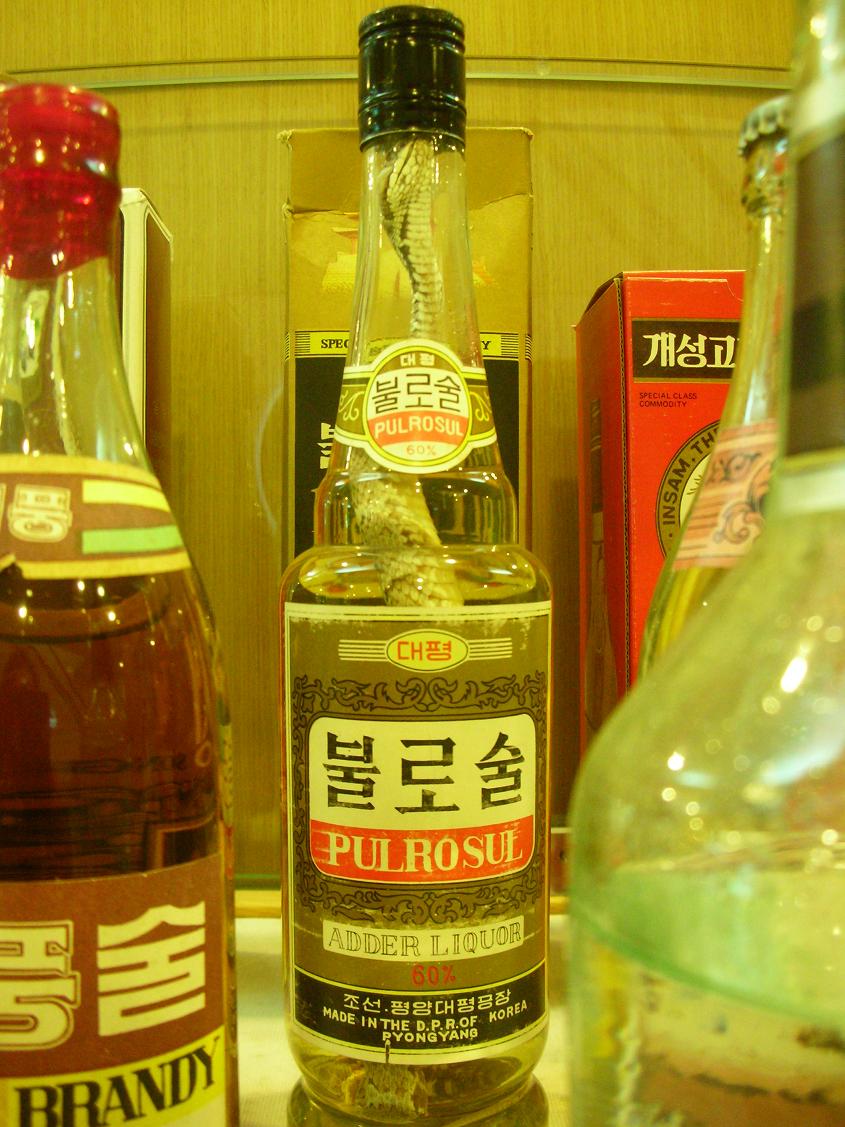
Weird alcohol complete with snake...

English textbook, published 1999.
I made my way through the observatory and came to a display room. A simulated North Korean classroom had been set up, complete with textbooks. They would have fit right in with the books that my mother still has from her Elementary school days, except that the publication date on the cover was 1999. The one English text book allowed some insight into the education of their children. Kim Jong Il was referred to as a warm and caring leader. I looked up from the book and saw his beady eyes, and those of his father Kim Il Song staring down at me. I moved along. The next room was filled with clothes, toys, books and tools that were considered to be modern in North Korea, all of them appearing to be from the 1930s. Beside these ancient tools were display cases of products produced in the north. I was well aware that there were clothing factories and that Hyundai had recently set up factories as well (not necessarily for cars, they make everything here). It was still shocking to see Samsung products alongside the old school wooden tops. The people working in the factories were evidently aware that their quality of life was quite different from the south.I couldn't say I was completely blown away by the experience. The trip had not educated me as much as I had hoped, had not put the issues directly in my face. But it did prompt a lot of thought about communism and democracy, about socialism and the market economy. There is no greater example of the extremes between the north and south of Korea. While southern Koreans strive to compete against their neighbours for the prettiest daughter, smartest son, biggest car and greatest display of brand name products, north Koreans struggle to survive. Many starve to death while my kids complain about their food being cold. As a child, I remember my parents telling me to finish my food and making me listen to stories about children starving in Africa. Having no idea where Africa was, and wondering why my parents didn't just give my Brussel sprouts to them, it had little effect on me. But I wonder what sort of awareness south Koreans have of this very issue. Their excess, while the other half of their country starves. As much as they speak of the pain of a divided nation, I can't help but wonder how much individuals actually think about how fortunate they are not to have been born forty minutes further north. The extent to which image rules the lives of the people here has shocked me since I arrived and will continue to shock me, even after I leave. I will never understand why a country with such a rich culture and history has become the world capital of plastic surgery- obsessed with bigger breasts, double eye-lids, rounder eyes, longer tongues. Why are they obsessed with being thinner, taller and covered in more European brand names than their neighbours? Are these principles anymore enriching to a person's life than those instilled by a dictator? South Koreans have chosen to allow themselves to be prisoners of materialism, while their friends and families to the north know absolutely nothing of the styles of Prada and Burberry. The two Koreas have gone such totally different directions, is unification even possible? Do they even hold anything in common anymore?

Kim Il Song and his son & successor, Kim Jong Il over the blackboard in a fake classroom.
Sunday, July 09, 2006
Missiles & Media
For Canadians, July 4th has nothing to do with the patriotism of our American neighbours. It doesn't involve fireworks or recitations of old speeches from hundreds of years ago. It's just another day. Another day to head to the nearest theatre and pour your hard earned money into the greedy hands of our American neighbours. Many Canadians celebrate Independence Day without even realizing that they've been suckered in. Each and every fourth of July, Hollywood releases yet another propaganda film about how America saves the world and for some reason, people go. Independence Day, Armageddon, Day After Tomorrow- all July 4th releases, along with countless others that my mind refuses to acknowledge. All these thoughts and more were swirling through my head as I made my way to Itaewon (Little America) on the 4th of July. As I walked the streets, I found it strange to find them empty on such a big American holiday. The streets had been packed only three days before for Canada Day... although it did coincide with two World Cup games, but I'm sure Canada Day was drawing the crowds. In light of the events of this week, I suspect they were probably on high alert- confined to the base and waiting.
Being here- in the thick of it, the distinction between America's view of the truth and the world's view of the truth has never been more skewed, or more clear. As I sat down at my computer on Thursday morning and signed into my email, the MSN homepage informed me of the launch of seven missiles by our friend, Kim Jong Il. Craving a Korean viewpoint, I ran off to the store to pick up a newspaper. I scanned the cover page- no mention of the missiles, or the North. I scanned each page of the paper and finally found an editorial at the back that referred to the potential threat by the launch of either a missile, or a satellite. The writer seemed to feel that it was nothing more than a satellite and the world was overreacting. It was written as though nothing had happened yet, and the threat level was still being analyzed. Apparently Koreans feel that way in general about the whole situation. I asked my Korean co-workers if they'd heard about the missiles, and they scoffed and said "They just wanted some attention, now they got it. What's the big deal?"
The Americans, I suspect are taking the whole situation a lot more seriously. South Korea maintains that they will continue to send food and other aid to the North, because it would be inhumane not to. The government is coming under scrutiny by the Americans for responding slowly and tentatively to the issue. Neither the President Roh (South Korea), nor his head Security Advisor attended the emergency meeting after the launch of the missiles. Stating that, ``We've decided it was not necessary for the president to hold an emergency meeting immediately after the launches in order not to stir any unnecessary tension and unrest on the Korean Peninsula,'' said Seo Joo-seok, senior presidential secretary for national security, in a briefing Thursday night. ``Hard-line approaches against the North would have exacerbated the situation.'' I think President Roh was probably too lazy to get out of bed. The meeting was held at 7am- I know I would never have made it.
Koreans do not distinguish between North and South Korea. I've been questioned as to why incoming mail for me specifies South Korea, and people look confused when I refer to the North. There may legally be a divide in the country, but not in the minds or hearts of Koreans. They mostly choose not to deal with the issue. And what else can you do when the most heavily guarded border in the world lies a mere 40 km north of your home? While South Korea has become known for its cutting edge technology, the North maintains laws that keep cameras out of the country. Even though they speak the same language and have the same cultural background- there could not be a greater contrast between these two countries in reality. Koreans have an innate faith in their country and their people. The entire social structure is based on family. Instead of using words like friend to establish your relationships with others, Koreans use older sister, younger brother, aunt, uncle for all their peers. This concept of society as a family bleeds into every aspect of the culture. My gym provides bar soap, brushes, tooth brushes and communal loofahs for its patrons. In Canada, we would think it disgusting to share these things but in the Korean family it's totally normal. When you buy any type of food, you're always given two forks or spoons- it's assumed you'll be sharing it. Bikes are left unlocked in the streets and strangers will talk to you with such respectful familiarity that you feel like you've known them years. It's beautiful. It's taboo to talk about crime in Korea, because they like to pretend it doesn't exist and isn't a problem here. They are quick to point to the US military as trouble makers, proven by the abundance of NO GI's signs that hang outside of bars- it's easier than accepting that one of their own could do such a thing. My older students showed up late for class the other day, apparently because they had biked to school. I asked them if they had locked their bikes downstairs. They looked at me, slightly surprised and slightly embarrassed and said that no, they hadn't. Aren't you afraid it'll be stolen, I asked. Of course, it's happened before, Min Su told me. But when I asked him why he didn't lock it, he shrugged his shoulders and said it would be okay. His innate trust in his huge family does not allow him to accept the idea that someone could steal from him.
All this taken into consideration, the reaction of the South to the brewing crisis makes a lot of sense. Not only from a cultural view point, but it's also common sense. Despite the US assertions that the North has outright threatened to use force if a test missile is shot down, it just doesn't make sense. Further, these direct threats have yet to be reported in the media here. It makes me wonder how much is American propaganda. The population of North Korea is malnourished, they're dropping in the streets from starvation. As ridiculous as any dictator may be, he cannot possibly believe that such a country could take on the US in a war. Russia was a threat, just by its size, technology and population. North Korea is like a child begging for attention. They just want someone to talk to them, and no one will. South Koreans see it for what it is. The US sees it as a slap in the face- they play it up as though it's a very real threat that the North could attack. They keep the world in fear of what stupidities will follow, as Bush enters into his second year of his second term. There is no real threat. Though the test failed after little more than forty seconds- a long way even from making it to Japan, Mr Bush I'm sure, will not want to leave this incident as part of his legacy. And that's the real threat. Not that North Korea will use nuclear weapons, but that the Americans will close in on them because Bush sees it as an affront to his delicate ego. He will be remembered as the President that started a war on the pretense of looking for nuclear weapons which didn't exist, but to turn a blind eye on the efforts of North Korea to gain attention for their nuclear program would make his legacy even more pathetic.
As I sit comfortably in my South Korean apartment, on my newly purchased laptop computer, my air conditioning blowing at full force, I contemplate the lives of the people living only half an hour north of me. Tomorrow I may finally make the trek to the border, to allow myself to be hit head on by the tensions that exist here. The producer of my show was in North Korea just last week. Anthony works for a company that has factories in North Korea and he went up to visit. The bus stopped at the border, and the North Korean army boarded the bus, carefully looking everyone up and down. You are not supposed to make eye contact, it can be seen as provocation. You are not to speak, it can be interpreted as political. As the bus continued on its way, it stopped as it reached its destination. The bus came to a halt and he descended from the bus, finding himself where few others have gone- in North Korea. A young girl greeted them in full military uniform. She wore a Kim Jong Il button. Anthony approached the girl and proposed a trade for his Australian pin. She looked appalled, taken back and scandalized. Anthony later discovered that the people of North Korea are required to wear these buttons whenever they appear in public, and can be shot if they are seen without it. They only get one button in their lifetimes. We have little to fear from the North, what I fear is the American presence here. They've declared war over less, and I wonder if I may be packing up and running home before October. Running back to a country that shares the longest undefended border in the world with the US- presently the scariest country on earth.
Sunday, July 02, 2006
A Dramatic Night Out
 Alex & I- I'm going on three hours of sleep after a night of noribong and eight hours of rehearsal... Alex just came back from Thailand, making me look even whiter than usual.
I was nine when I moved to Calgary and the school year had already started, and though I was excited to move to a big city, I was scared to make new friends. I was terrified my first day at St Gerard school. I wondered if the kids would like me, would they be different from small city kids? Would the teachers like me? Of course my fears were unfounded. I soon made friends despite the fact that even at nine I was a know it all. The friends I made were, of course, very much like me. We enjoyed the same stupid games, and coasted our way through school. We were smart, and quiet- a combination teachers love. I've lost touch with most of my friends from elementary school, but Alex and Thelma remain close friends. We've gone years without seeing each other, but it always seems we're on the same page when we do. We live in different parts of Canada, and currently all three of us are overseas, in different countries. Somehow it works though. In high school, we started drifting apart. We all went to different high schools, Alex and I in Calgary, and Thelma in Ottawa. Alex and I had very different friends, but when we met up, it seemed we were getting into the same sort of trouble. My talks with Thelma were few and far between, but it seemed she was in the same place as Alex and I. As high school drew to a close, Alex and I began to make plans to move in together. And our prodigal friend returned from Ottawa.

Our favourite pre-show warm-up; Catch with glow-in-the-dark balls.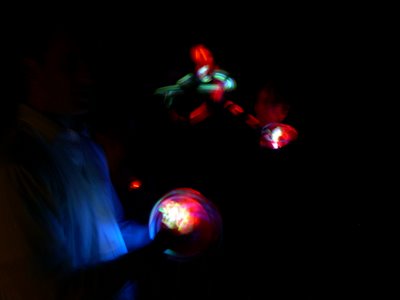
In Junior High, Alex, Thelma and I had been partners in our home ec class. We soon learned that not one of us had any sort of abilities in the kitchen. Our first task was to make a smoothie with egg and cinnamon and some other spices. Sounds easy enough, I'm sure. All three of us managed to misread the instructions, so there was a tablespoon of nutmeg instead of a teaspoon. It was disgusting, but we drank it anyway- hoping our mistake would not be uncovered. An argument ensued afterwards about who would do the dishes - all of us of course, had been spoiled by dishwashers, and not up for doing things the old fashioned way. The next class, our teacher guided us into a more difficult project. We were nervous, seeing as how we didn't exactly master the first one. Pigs in a blanket. We took great care to make sure that all of our measurements were right. We slid the tray into the oven and cleaned up as we waited for them to bake. We again argued about who would do the dishes. Twenty minutes later, we peaked into the oven to see how the pigs were coming. They looked the same. We closed the door and left them in another ten minutes. Then we checked again. Their blankets were not even the slightest bit brown, in fact, not even the cheese was melted. It was then that we realized we hadn't turned the oven on. We finished off the semester by burning our final project, if I remember correctly.
September 1st 1998, Alex and I moved in together- some five years after our home ec incidents. We moved into an empty apartment, excited to have our first home independant of our parents. We hadn't planned ahead. We had saved up enough to account for bills and rent, but not for furniture or kitchen things. We ordered KFC that night, and realized we didn't have any cups or plates. We made an emergency run to Walmart and returned home with the basics. But still something was missing. Furniture. We looked around our apartment, empty but for a few knick knacks. Luckily, friends and family donated many of the missing items. Andrea's grandmother gave us a kitchen table, a bed, end tables and a cool green lamp that I still have. Alex's family gave us some dishes and my dad contributed a TV. Alex's boyfriend bought us a purple, inflatable couch. We were always tempted to fill the couch with water and get some fish, but neither of us liked the idea of fish staring at our butts. Despite our strict rules for the couch (no keys, no coffee), it soon popped - leaving us couchless. Fortunately a friend soon came through with one that his family had deemed too ugly to keep- even in their basement.
Totally unrelated to tales of old friends- our article from the Korea Times- that's me way up high on the chair.
It was immediately obvious that neither of us had gained any skill in the kitchen since our days in home ec. Our trips to the grocery store involved the purchases of processed, micro-waveable foods, ice cream and cheesecake. Our bills and rent were never late, but when we finally got around to the dishes, it usually took a few hours. We bought new clothes instead of bothering with laundry. The apartment was in a constant state of disaster. But it was a good and easy year. When you've known someone eleven years, there are few surprises- even if it's the first time you've lived together.
Alex and I have always been perpetually in relationships. While Alex has had several (in my opinion) long relationships, I've repeated the same short-lived mistakes again and again. This year was no exception, and our individual relationship habits stood out more than usual, contrasted against each other. I hated her new boyfriend, and she hated my old one (yet new again).
The year drew to a close, and our lease nearly up, Alex packed her things and moved to BC for school. My ex-boyfriend (see, repetitive mistakes) moved in for the remainder of the lease and my stories with crazy roomates soon began. I didn't realize how much things would change until afterwards. Alex and I have drifted at points, then found each other again. For awhile, she would come back to Calgary at Christmas. Then I moved to Montreal, and we were never home at the same time. When Alex arrived in Seoul last month, it was the first time we'd seen each other in five years. What's alarming is how much we've both changed, yet somehow we're still on the same page. We've both fought our seperate battles, graduated from different programs, fallen into different groups of friends. We've travelled. We've fallen in and out of relationships- and right back in again. Suddenly it seemed the tables had turned. Alex arrived in Seoul describing her trip to Thailand with her old (yet new) boyfriend- reemerged from our Calgary days. I contemplated how strange it was that I had been with Fred nearly four years and Alex had still not met him. After Alex left, I looked around the apartment at the mess that surrounded me. The past eight months in Korea have turned me into somewhat of a clean freak when it comes to my apartment- though it seems that I quite readily returned to my old ways with Alex there. Clothes and towels strung about all over the apartment- a sink overflowing with dishes (some even appeared to be growing legs and walking out on their own) and an empty fridge. Alll reminders that some things never change. My stove had not been turned on all week- except to make coffee.
As I think about friendship, it shocks me how many people have come and gone from my life that I was once close with, but now have no idea where they are or what they're doing. I've heard rumors of big moves, of marriage and babies but I can't tell the truth from stories at this point. Important people seem to creep into your life and stay through a string of odd circumstances. Many of my close friends could have fallen to the sidelines if any number of variables had turned out differently. At our cast party last night, we celebrated the end of our two week run with dinner and drinks. Keeping with tradition, the party was quite dramatic. To begin with, it seems that I was once again overly critical of the show- or I'm entirely too pretentious to appreciate theatre that can actually be understood by an audience... one or the other. The audiences loved the show and we received a good deal of media attention. We were written up three times in the paper (once with photo on front page) and were interviewed for our talk show on KBS online. This'll teach you never to listen to my opinion about a show I'm in.
 From Left- Emily, Ed, Steven, Sean, Me and Mackenzie
 In any case, our producers, Jono and Anthony treated us to dinner and paid for the first round of drinks at a bar in Little America. They invited us to come to Hongdae with them, where they had met DJs at a club and could get everyone in free. My director, Krista shot them down. She was determined to stay in Little America (selfishly, in my opinion because that is where she happens to live). We picked up and moved to a bar down the street. All was well until they rolled in the TV to show the England vs Portugal game. While all of us- save one, settled down and began watching the game with interest- Krista tapped us on the shoulder. We're going, she said. Apparently when one spends a hundred dollars on a dress, one cannot watch soccer in said dress. I'd criticize but what the hell do I know about the rules for dresses? Anyway, Jono stayed behind determined to watch the game. And then we were ten -we moved on. Anthony found a small nightclub with live music, and as we made our way down the stairs we were again tapped by the almighty director. The cast had yet to spend a dime, but she thought 10$ cover was too much. We moved on, losing Anthony and Ryan to the game. Two of my cast members who recently started dating picked up and left- they were having their first fight.
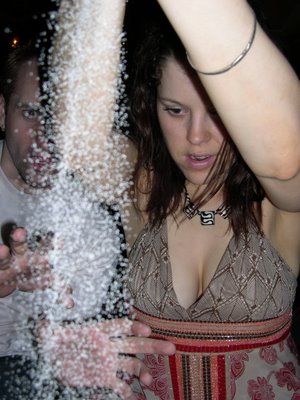 Krista & Sean- playing with sand from the floor
of The Bungalow at the cast party...
Moving from bar to bar, we found ourselves at a cheezy night club called Polly's Kettle. The bar serves 'kettles' (kool-aid with a shot of soju) in two liter bottles with the top cut off. Classy place. It being Canada Day, I was quite happy that I was not presently up to my ears in boxes and could take in the Canadian music blasting from the speakers. As 'Home for A Rest' started, the confused Americans cleared the way and all the Canadians took to the dance floor. Our honorary Canadians, Mackenzie and Sean put in a good effort, in spite looking a little confused by the madness that surrounded them. Krista and Sean (her boyfriend and my cast mate) got into a fight about something or other and both soon vanished from the bar- leaving Mackenzie and I with our Stage Manager, Craig. It always amazes me how ridiculous actors are within our artificial world. During rehearsals- the show seems to invade every aspect of life- it's all you do and all you think about. Hours of each day are spent lost in thought about themes and characters and relationships. We lose ourselves in the world. We become confused. Where does fantasy end and reality begin? Sometimes it's hard to tell. Your relationships as actors come to mirror the relationships of your characters. The dynamic of each cast was so completely different. The first show was called 'This Is A Play" and poked fun at actors and the world of theatre. It dealt with different types of actors- and funny enough two of the three actors were somewhat like the characters they portrayed onstage. The onstage love/hate relationships mirrored the offstage love/hate relationships. With our show, Krista took care to ensure that there my character would not flirt or have any sort of intimate moments with her boyfriend's character- despite the fact that it left the play unbalanced. This again, mirrored in our personal relationship- or lack thereof. As our party got smaller and smaller with the demands of our ring leader, it got me thinking about friendship. For three months, Ed, Sean and I were so much apart of each others lives and thoughts- yet like the show itself, once the lights go down and the set is symbolically torn apart, the relationships made quickly become faded memories. We only existed to each other for a few short months and when Ed stops being Frank, and Sean stops being Bill- it's all over. If ever we meet again, we'll feel like strangers. Like every other show I've done, promises to keep in touch and nearly tearful good-byes were exchanged, but more admirable were those who could be honest. "I'll never see you again. So good-bye and take care." At least someone brought a little truth to the party with them last night. Like all real relationships, theatre has made me experience quite possibly every human emotion- both onstage and off. There are things I love and things I hate about it. As I contemplate my posting from a few weeks back about the show and the frustration expressed, I have to remind myself that I've always hated the rehearsal process. That it never feels real or complete until opening night. That my quest for perfection in my work is all in vain. No matter how much I grow as an actor and consequently as a person, there will still be room for more growth. Those who knew me in my pre-Fred days (oh-so long ago) know well of my absolute fear of commitment. As terrifying as I find it to commit to a person, it is equally terrifying for me to commit to theatre. Committing means that I've grown up- that I've made a choice. That despite all the hardships that I'll take it, for better or for worse- frustrating directors, painfully challenging roles, long periods of unemployment, lack of control over success or failure, instability- that I'll take it all that for those moments on stage where I feel lost in it. It's been eleven years now since I was first introduced to theatre- eleven years since our first encounter and I wonder if it's time to commit or time to jump ship. Like always, the end of a show leaves me with more and more questions... just when I started to think that I'd put the whole thing to rest.
 Playing Dead -
I spent the first ten minutes of the play under the sheet hoping not to pass out with the lights shining down on me and cursing the broken air conditioner...
Sunday, June 25, 2006
Shitty Metaphors
Despite the fact that my parents are divorced (or more accurately, permanently separated), I have to admit that there are many things that I've never understood about it. Not just their divorce, but divorces in general. How you can be so in love one day and then just watch it all fall apart? How can people that once shared so much be so cruel to one another? And why are people so stupid about relationships? Fear not- this will not be an analysis of the institution of marriage and its relationships, I haven't the patience for that.
As a child, I remember hearing tales of couples divorcing over a toilet seat left up one too many times, or differing opinions on whether the paper should hang from the front or the back. In my innocence, divorce for such trivial reasons sounded utterly ridiculous, and though I doubt my parents ever told me I would understand when I was older, I fear I'm starting to. There are few places in the world that even Hollywood movie crews fear going, and one of them is the bathroom. It's too private. No one wants to be seen in there. Many of us have weird bathroom rituals that we don't want to admit to, let alone be seen doing. I for one, refuse to touch the flusher with my hand and use only my feet. Not so weird until you picture someone contorting their body into pretzel-like forms because Korean bathrooms are too small to allow you to stretch your leg out. I had a crazy roomate who went one step further and would use his feet to turn on the taps. Though some of you, I expect, are rolling your eyes and laughing at my fanatical fear of bathroom germs, I'm sure you have your own strange habits. After all, when it comes down to it, we spend alot of time in the bathroom- be it in the shower or bathtub (oh how I miss you, bathtub), in front of the mirror or using the toilet.
By now you're probably wondering if I've lost my mind. Has she completely run out of things to say? Is that why she is writting about bathrooms? Well, not quite. Although maybe that's a sign of things to come if I'm finding ideas in toilet paper. When I lived in Canada- Montreal or Calgary, I knew where to find the clean bathrooms in the city. I would run through a list in my head of the closest possibilities and make my way there- even if it was out of the way. The bathrooms at Cine (Montreal cafe) were sometimes so bad, I'd opt for the bar next door. Or even run two blocks and up four flights of stairs to use my own bathroom. Living in Korea has definitely brought about a new appreciation for Canadian bathrooms. Korean ones often feature porcelain squattors instead of toilets. Often times there is no toilet paper in the bathroom. The water from the taps is always cold and the only soap that ever seems to be available is bar soap. I suppose this comes from the Korean concept of community- but I'm just not big on using the same soap as everyone else's dirty little hands. So I carry hand sanitizer and tissue with me everywhere I go. Wondering how I've survived so long? Me too. Though it's standard for bathrooms to lack in tissue, there is almost certainly a 'courtesy box' in each stall. The courtesy box has a small speaker, and with the touch of a button will produce the sound of a toilet flushing - just in case you're shy. Often bathrooms here are unisex- resulting in some awkward maneuvering as you try to pass the man standing at the urinal on your way to the stall.
Bathrooms are so much a part of our private life that this is perhaps where we seem to exhibit the most particularities. Having lived with quite a few roomates, I've come to understand just how particular people can be about their bathroom space. Tensions can rise around the issues of bathroom set-ups and time sharing. Alex and I started off our year together by bonding in the bathroom as a result of our KFC-induced food poisoning. Perhaps our ability to share the space in such a miserable time allowed us to get along better as a result... or maybe not- who knows? When I lived in the house of IMAXers + ex-boyfriend, tensions rose as we realize that all of us were making use of our claw-footed bathtub for different purposes.... some of them disturbing- especially when you consider the number of people living in that house. When I first arrived in Montreal, you may remember the tale- I was living with a lunatic. I quickly moved in with my director, Ross. Ross was a sweetheart, but had a problem with cleaning. The first time I showered at his place, I wondered about the odd colour of his bathtub. I had never seen a black bathtub before. A quick wipe with my finger revealed that it should in fact be a pale blue- a fact that even Ross had forgotten. My first St Henri apartment came sans door or bathroom sink- obviously leading to some awkwardness in the first few weeks of residency. My second St Henri apartment came with a skylight in the bathroom. It was beautiful- you could look up at the stars while having a shower. But then summer gave way to fall, and fall to winter and soon there was snow in our bathroom. But I'll get to the point. Once upon a time, Fred and I lived with Luke and Nouria in a tiny apartment on St Catherine Street. While we are all good friends, the boys have some odd peculiarities and as luck would have it, they don't match. Fred spent much of his time at Cine, his coffee shop for the last... many, many years. Luke spent his time at Cock 'n Bull, the bar next door. They were like night and day. Fred dragged himself from his bed at 9am (four days out of five, anyway), across the street and into his office building. Luke would drag himself out of bed some time in the early afternoon, and then rush off to work at the bar in the evening. Fred enjoyed cooking, Luke was king of McDonald's. Fred almost killed me for twice-dipping a knife into the mayonaise jar (he seems to believe that bread crumbs in the mayonaise corrupt the whole jar). Luke was particularly attached to a particular brand of toilet paper. And thus began the problems. We took turns buying toilet paper- Luke and Nouria would buy once, and the following time Fred and I would buy. This particular brand of toilet paper could only be purchased at the mall three blocks out of our way. Three blocks is not far unless you consider that Fred, who lived, worked and played all within a three block radius had no reason to venture outside of it. Except to get toilet paper. So eventually respect for the particularities of toilet paper gave way to laziness and we started buying other brands of toilet paper. The change seemed smoothe- neither Luke or Nouria mentioned their annoyance with the new toilet paper- until one night when Nouria stumbled in a little drunk. Then it all came out. It seemed that tensions were rising around the toilet paper issue, and it was believed that we were purposely trying to provoke them. Why was it so hard to comply with Luke's toilet paper wishes? Hadn't we noticed that our new brand clogged the toilet (no, we hadn't)? Secondly, it had been their turn to buy toilet paper, didn't we trust that they would remember? Had they ever forgotten before?I can't remember for the life of me the outcome of this dicussion- whether we continued to buy the 'other' toilet paper, or if we switched back to the roomate-approved paper. Either way the toilet paper discussions were simply a microcosm of the problems that arose between Luke and Fred that year- leaving Nouria and I awkwardly in the middle. Though tensions rose and fell throughout the year, we've all managed to stay friends- but clearly these two were not meant to live together...
Last week as I sat, infuriated in my boss's office, listening to him talk about his latest idea for completely wasting my time, this issue once again came to my attention. Over the past eight months, my boss has proven himself too cheap to provide us with proper health insurance and pension benefits (both required by law), attempted to house me in biggest dump I have ever set foot in and tried to talk me out of air conditioning. In discussion about moving children from one class to another, or simply out right admitting that we don't have an appropriate level for the student he has been known to use his absolutely favourite phrase, "That is not profitable". Pretty impressive for a man with very poor English, although I guess this is an important sentence for an accountant. In any case, as I sat in the office arguing with him about whether or not it was a waste of my time to record for him 200 books onto CD (and, as I threw, a violation of my contractual agreements with my agent in Canada... a blatant lie since I have fired my agent, but he doesn't need to know that), the issue of toilet paper crept up once again. It is not enough that this man has carefully manipulated my schedule over the last eight months so that it went from bad to worse, or that he feels that he can drag us in on Saturdays to help him move schools, or come up short on our contractual agreements, or ask me the same question twelve different ways hoping I'll forget what I had told him last time. Now the man feels that he has the right to regulate my use of toilet paper. Let me explain. Our school is on the sixth floor of an office building, and the kid's bathrooms are located in the school. The teachers, however, have to use the building's bathrooms down the hall- one of the infamous Korean bathroom, that though clean- is free of such conveniences as toilet paper and soap. So every morning, I bring a roll of tissue with me to the bathroom and leave it there for everyone's convenience. Apparently my boss is becoming very concerned with the fact that the roll of tissue is being shared amongst all the women on the floor, and not just his employees. Apparently this one roll of tissue is going to break the bank. He requested that I pass on to the other teachers that we should only be taking enough tissue to the bathroom for that time. And I told him to call the building manager and find out why there was no tissue in the bathroom. Of course, once we realized how closely he monitored his tissue stock, we all began bringing rolls of tissue to the bathroom- this way he's wasting not one roll a day, but at least four. Though satisfying that it's giving me the opportunity to be a brat, the fact that the issue came up is absolutely disgusting. Because this man employs me, and further, because he has paid for my plane ticket here and is housing me, he feels that he owns me for the duration of one year. He feels that he can go so far as to regulate my use of toilet paper- when no where in my contract does it stipulate that I should have to abide by his desperate money-saving measures. Though it does say that he owes me a year of health insurance, paid vacation and the government pension plan. Eight months down, four to go. Here I am in Korea, and loving it- but it's clear that my job is absolute shit and there isn't enough tissue in the whole school to clean up his stupid mess. And even if there was, I wouldn't be allowed to use it so wastefully.
As a child, I remember hearing tales of couples divorcing over a toilet seat left up one too many times, or differing opinions on whether the paper should hang from the front or the back. In my innocence, divorce for such trivial reasons sounded utterly ridiculous, and though I doubt my parents ever told me I would understand when I was older, I fear I'm starting to. There are few places in the world that even Hollywood movie crews fear going, and one of them is the bathroom. It's too private. No one wants to be seen in there. Many of us have weird bathroom rituals that we don't want to admit to, let alone be seen doing. I for one, refuse to touch the flusher with my hand and use only my feet. Not so weird until you picture someone contorting their body into pretzel-like forms because Korean bathrooms are too small to allow you to stretch your leg out. I had a crazy roomate who went one step further and would use his feet to turn on the taps. Though some of you, I expect, are rolling your eyes and laughing at my fanatical fear of bathroom germs, I'm sure you have your own strange habits. After all, when it comes down to it, we spend alot of time in the bathroom- be it in the shower or bathtub (oh how I miss you, bathtub), in front of the mirror or using the toilet.
By now you're probably wondering if I've lost my mind. Has she completely run out of things to say? Is that why she is writting about bathrooms? Well, not quite. Although maybe that's a sign of things to come if I'm finding ideas in toilet paper. When I lived in Canada- Montreal or Calgary, I knew where to find the clean bathrooms in the city. I would run through a list in my head of the closest possibilities and make my way there- even if it was out of the way. The bathrooms at Cine (Montreal cafe) were sometimes so bad, I'd opt for the bar next door. Or even run two blocks and up four flights of stairs to use my own bathroom. Living in Korea has definitely brought about a new appreciation for Canadian bathrooms. Korean ones often feature porcelain squattors instead of toilets. Often times there is no toilet paper in the bathroom. The water from the taps is always cold and the only soap that ever seems to be available is bar soap. I suppose this comes from the Korean concept of community- but I'm just not big on using the same soap as everyone else's dirty little hands. So I carry hand sanitizer and tissue with me everywhere I go. Wondering how I've survived so long? Me too. Though it's standard for bathrooms to lack in tissue, there is almost certainly a 'courtesy box' in each stall. The courtesy box has a small speaker, and with the touch of a button will produce the sound of a toilet flushing - just in case you're shy. Often bathrooms here are unisex- resulting in some awkward maneuvering as you try to pass the man standing at the urinal on your way to the stall.
Bathrooms are so much a part of our private life that this is perhaps where we seem to exhibit the most particularities. Having lived with quite a few roomates, I've come to understand just how particular people can be about their bathroom space. Tensions can rise around the issues of bathroom set-ups and time sharing. Alex and I started off our year together by bonding in the bathroom as a result of our KFC-induced food poisoning. Perhaps our ability to share the space in such a miserable time allowed us to get along better as a result... or maybe not- who knows? When I lived in the house of IMAXers + ex-boyfriend, tensions rose as we realize that all of us were making use of our claw-footed bathtub for different purposes.... some of them disturbing- especially when you consider the number of people living in that house. When I first arrived in Montreal, you may remember the tale- I was living with a lunatic. I quickly moved in with my director, Ross. Ross was a sweetheart, but had a problem with cleaning. The first time I showered at his place, I wondered about the odd colour of his bathtub. I had never seen a black bathtub before. A quick wipe with my finger revealed that it should in fact be a pale blue- a fact that even Ross had forgotten. My first St Henri apartment came sans door or bathroom sink- obviously leading to some awkwardness in the first few weeks of residency. My second St Henri apartment came with a skylight in the bathroom. It was beautiful- you could look up at the stars while having a shower. But then summer gave way to fall, and fall to winter and soon there was snow in our bathroom. But I'll get to the point. Once upon a time, Fred and I lived with Luke and Nouria in a tiny apartment on St Catherine Street. While we are all good friends, the boys have some odd peculiarities and as luck would have it, they don't match. Fred spent much of his time at Cine, his coffee shop for the last... many, many years. Luke spent his time at Cock 'n Bull, the bar next door. They were like night and day. Fred dragged himself from his bed at 9am (four days out of five, anyway), across the street and into his office building. Luke would drag himself out of bed some time in the early afternoon, and then rush off to work at the bar in the evening. Fred enjoyed cooking, Luke was king of McDonald's. Fred almost killed me for twice-dipping a knife into the mayonaise jar (he seems to believe that bread crumbs in the mayonaise corrupt the whole jar). Luke was particularly attached to a particular brand of toilet paper. And thus began the problems. We took turns buying toilet paper- Luke and Nouria would buy once, and the following time Fred and I would buy. This particular brand of toilet paper could only be purchased at the mall three blocks out of our way. Three blocks is not far unless you consider that Fred, who lived, worked and played all within a three block radius had no reason to venture outside of it. Except to get toilet paper. So eventually respect for the particularities of toilet paper gave way to laziness and we started buying other brands of toilet paper. The change seemed smoothe- neither Luke or Nouria mentioned their annoyance with the new toilet paper- until one night when Nouria stumbled in a little drunk. Then it all came out. It seemed that tensions were rising around the toilet paper issue, and it was believed that we were purposely trying to provoke them. Why was it so hard to comply with Luke's toilet paper wishes? Hadn't we noticed that our new brand clogged the toilet (no, we hadn't)? Secondly, it had been their turn to buy toilet paper, didn't we trust that they would remember? Had they ever forgotten before?I can't remember for the life of me the outcome of this dicussion- whether we continued to buy the 'other' toilet paper, or if we switched back to the roomate-approved paper. Either way the toilet paper discussions were simply a microcosm of the problems that arose between Luke and Fred that year- leaving Nouria and I awkwardly in the middle. Though tensions rose and fell throughout the year, we've all managed to stay friends- but clearly these two were not meant to live together...
Last week as I sat, infuriated in my boss's office, listening to him talk about his latest idea for completely wasting my time, this issue once again came to my attention. Over the past eight months, my boss has proven himself too cheap to provide us with proper health insurance and pension benefits (both required by law), attempted to house me in biggest dump I have ever set foot in and tried to talk me out of air conditioning. In discussion about moving children from one class to another, or simply out right admitting that we don't have an appropriate level for the student he has been known to use his absolutely favourite phrase, "That is not profitable". Pretty impressive for a man with very poor English, although I guess this is an important sentence for an accountant. In any case, as I sat in the office arguing with him about whether or not it was a waste of my time to record for him 200 books onto CD (and, as I threw, a violation of my contractual agreements with my agent in Canada... a blatant lie since I have fired my agent, but he doesn't need to know that), the issue of toilet paper crept up once again. It is not enough that this man has carefully manipulated my schedule over the last eight months so that it went from bad to worse, or that he feels that he can drag us in on Saturdays to help him move schools, or come up short on our contractual agreements, or ask me the same question twelve different ways hoping I'll forget what I had told him last time. Now the man feels that he has the right to regulate my use of toilet paper. Let me explain. Our school is on the sixth floor of an office building, and the kid's bathrooms are located in the school. The teachers, however, have to use the building's bathrooms down the hall- one of the infamous Korean bathroom, that though clean- is free of such conveniences as toilet paper and soap. So every morning, I bring a roll of tissue with me to the bathroom and leave it there for everyone's convenience. Apparently my boss is becoming very concerned with the fact that the roll of tissue is being shared amongst all the women on the floor, and not just his employees. Apparently this one roll of tissue is going to break the bank. He requested that I pass on to the other teachers that we should only be taking enough tissue to the bathroom for that time. And I told him to call the building manager and find out why there was no tissue in the bathroom. Of course, once we realized how closely he monitored his tissue stock, we all began bringing rolls of tissue to the bathroom- this way he's wasting not one roll a day, but at least four. Though satisfying that it's giving me the opportunity to be a brat, the fact that the issue came up is absolutely disgusting. Because this man employs me, and further, because he has paid for my plane ticket here and is housing me, he feels that he owns me for the duration of one year. He feels that he can go so far as to regulate my use of toilet paper- when no where in my contract does it stipulate that I should have to abide by his desperate money-saving measures. Though it does say that he owes me a year of health insurance, paid vacation and the government pension plan. Eight months down, four to go. Here I am in Korea, and loving it- but it's clear that my job is absolute shit and there isn't enough tissue in the whole school to clean up his stupid mess. And even if there was, I wouldn't be allowed to use it so wastefully.
Subscribe to:
Posts (Atom)


